T-Rex papercraft template
Make a t-rex in folded cardstock. Dry-fit the two jaw tips before the neck. The short forearm turns inward toward the chest. Keep both hind feet aligned while attaching the back.
- Finished size (W × H × D)
- 89 × 55 × 20 mm
- Difficulty
- Intermediate
- Cardstock
- 160–200 gsm
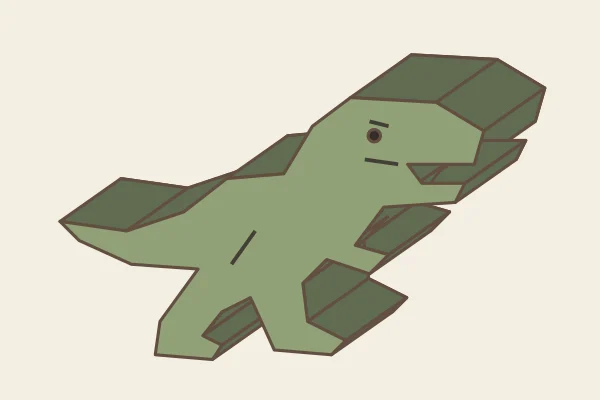
T-Rex papercraft template materials and scoring
- Two sheets of 160–200 gsm cardstock, scissors, a ruler, a blunt scoring tool and paper glue.
Step by step
- Print the plates and bands. Choose A4 or US Letter, print both sheets at actual size and measure the 25 mm bar. Plate A is the front and B is its mirror. Cut both outer contours, leaving the numbered edge map intact.
- Prepare the numbered strips. The 3 strips form 34 wall panels. Score every dashed line while the sheet is flat, then cut the solid outline around each strip, keeping the two rows of tabs and the end flap. Edge 28 is the shortest at 3.6 mm. Pinch that crease against the ruler.
- Fit the front profile. Dry-fit the two jaw tips before the neck. The short forearm turns inward toward the chest. Keep both hind feet aligned while attaching the back. With the printed strip numbers facing inside, match panel 1 to edge 1 on the map. Glue one row of tabs to the inside of A, working around the numbered outline. Join the end flaps behind the next strip.
- Close the back. Use plate B to check the fit before adding glue. Fold the free row of tabs inward and attach B in short sections. Check that the finished piece is 20 mm deep at both ends. Add drawn details to the face if desired.
Planning the t-rex build
The finished piece measures 89 mm across and 55 mm high when you look squarely at the front. The side wall adds 20 mm of depth. Trace the open jaw and the gap between the legs onto a scrap. Test how the inward corners reverse the direction of the wall strip. If they buckle, return to the scored line before moving to the adjacent outward turn.
Allow about 60–80 minutes of hands-on work as a planning estimate, plus drying time for your glue. There are 34 numbered wall panels to bend. If you are new to cutting models, begin with the front and leave the side strips for a second sitting. Keep the edge map on the table between sessions so you can find your place again.
Reading the edge map and checking the fit
Choose the file that matches the paper loaded in your printer. Both editions give the same finished dimensions. If the scale bar is short, turn off fit-to-page and print again before cutting anything. For a colour finish, test a pencil or marker on the unused margin. Some markers bleed through card and can hide the scoring marks on the other side.
For this outline the bands cover edges 1–14, 15–32, 33–34, in that order. Together they travel approximately 327 mm around one face. Separate the bands one at a time. Write their first and last numbers on scrap slips and lay the strips beside them. A slipped strip can look almost right until you reach a corner that bends the opposite way.
Edge 7, about 18.0 mm long, is a useful straight reference. Lay that panel against the matching line with no glue and hold both ends level. Then try edge 28, only 3.6 mm. If that corner springs open, deepen the score on the waste side of a test strip and try the same pressure on the real hinge.
Finishing the t-rex and correcting a twisted seam
Pencil the eye just above the mouth recess. The jaw gap is part of the outline. Keep adhesive off both tips so they stay visibly separate, and support the tail when laying the dinosaur on its side.
Place the unglued back over the standing walls and sight along the long reference edge. If one end lifts, trace the numbers back to the last joint that sits flush. Check the band order and fold direction there before pressing the back down. Allow the adhesive to grab with both plates parallel. A control print and digital assembly view are available here. A learner build with paper is still pending.